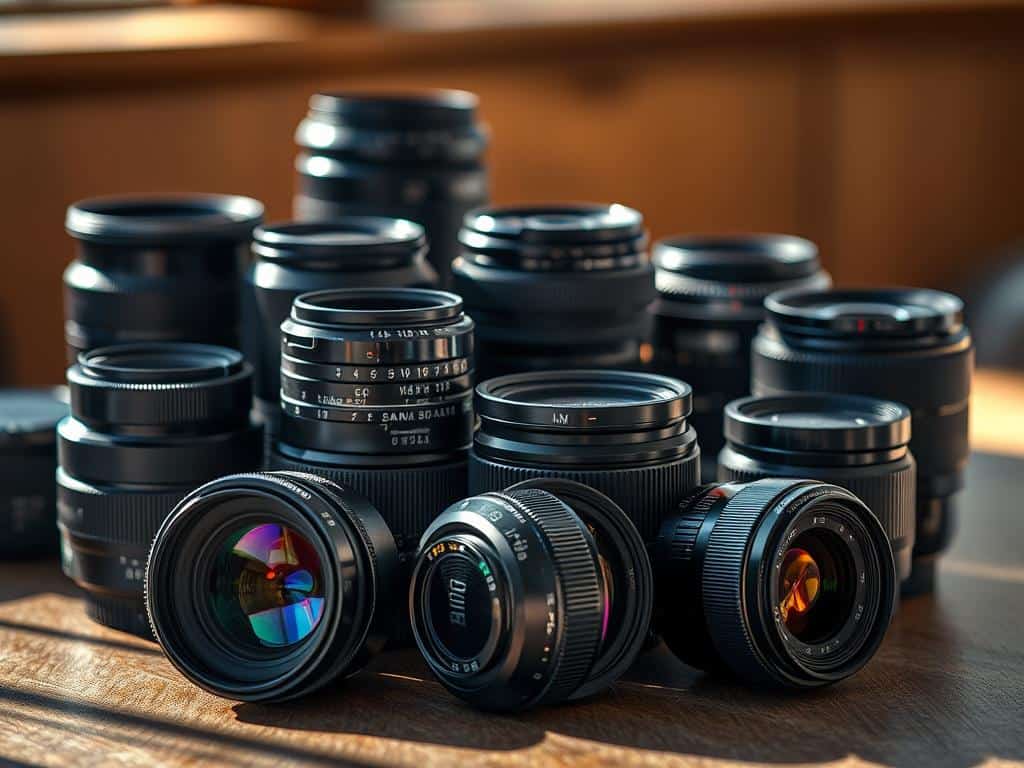
Did you know over 100,000 photography fans subscribe to a newsletter? They’re looking for tips on taking amazing photos. Choosing the right camera lenses is key to improving your photography skills.
Choosing the right camera lenses is more than just a preference. It’s about bringing my creative vision to life and taking incredible photos. With so many options, picking the right one can be tough. Interchangeable lenses are vital for photography, turning good photos into great ones. In this article, I’ll share tips on picking the right lens for your style.
Key Takeaways
- Choosing the right camera lenses is essential for improving your photography.
- Understanding focal lengths and apertures is key for different photography styles.
- Compatibility with your camera system is important when choosing lenses.
- Different photography genres, like wildlife or portraits, need specific lens choices.
- Exploring both prime and zoom lenses can make your shooting more versatile.
Understanding Camera Lenses and Their Importance
Camera lenses are key parts of any photography setup. They play a big role in how images are captured. Knowing how lenses work is vital for photographers to grow.
Each lens type changes image quality, perspective, and depth of field. The right lens lets me create specific visual effects. The focal length, in millimeters, shows a lens’s capabilities.
For example, a 50mm prime lens gives a unique view. A zoom lens, like 18-55mm, lets me adjust frames easily.
Lenses with different maximum apertures greatly affect my work. Wide apertures in prime lenses let in more light, helping in low light. Telephoto lenses with vibration reduction help me shoot steady handheld shots.
Choosing the right lens is key to my photography. Lenses are as important as the camera body. To improve, I need to learn about different lenses and how they enhance my photos.
Factors to Consider When Choosing Camera Lenses
Choosing the right camera lenses is key. Focal length and aperture sizes are critical. They affect the look and feel of my photos, from the scene’s composition to the lighting.
Focal Length and Its Implications
Focal length shapes the perspective and composition of my photos. Kit lenses, usually 18-55mm, are versatile for everyday shots. To see the world like our eyes, I use lenses between 35mm and 50mm.
Macro photography, focusing on small details, uses lenses from 85mm to 150mm. Ultra wide-angle lenses, 8mm to 24mm, capture big scenes. Wide-angle lenses, 24mm to 35mm, are great for landscapes and buildings.
Standard lenses, 35mm to 85mm, suit many photography styles. For portraits, I prefer lenses from 85mm to 135mm. Telephoto lenses, 100mm to 800mm, help isolate subjects at a distance.
For wildlife shots, super telephoto lenses, 800mm to 2000mm, are vital. My lens choice depends on the focal length needed for my photos.
Aperture Sizes and What They Mean
Aperture sizes, shown by the “f” number, control exposure and depth of field. A smaller f-number means a wider aperture, letting in more light. This is useful in low light.
For landscapes, I use apertures like f/8, f/11, or f/16 for a sharp scene. In portraits, wider apertures blur the background, creating a focus on the subject.
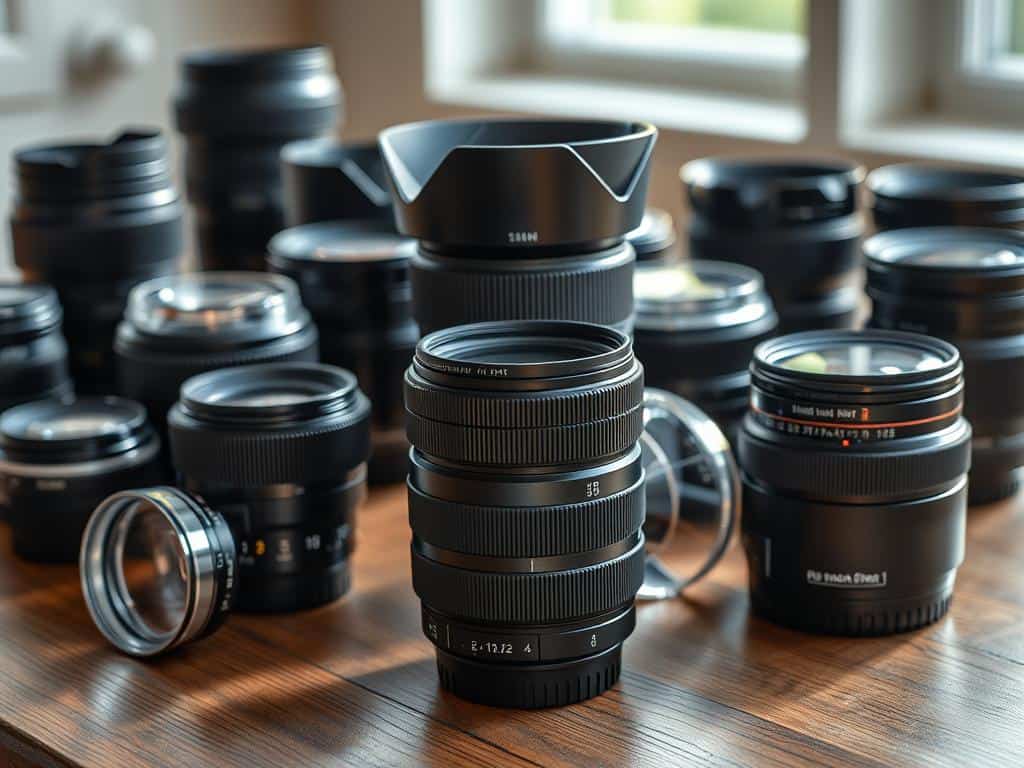
Different Types of Camera Lenses for Various Photography Styles
Exploring different photography styles shows me how important camera lenses are. Each type has its own benefits, whether I’m shooting landscapes, portraits, or action shots.
Prime vs. Zoom Lenses
Prime lenses have a fixed focal length. They range from 6mm for fisheye to 600mm for telephoto. They’re great for portraits and wedding photos because of their excellent image quality.
Normal lenses, around 50mm, are like our eyes. They’re perfect for catching candid moments.
Zoom lenses, on the other hand, offer flexibility. They can go from 16-35mm for wide shots to 70-200mm for close-ups. A 24-105mm lens is great for changing scenes quickly. This is super useful at events or in nature.
Specialized Lenses for Specific Needs
For specific needs, certain lenses are essential. Wide-angle lenses are best for landscapes. They show both near and far with great detail. Fisheye lenses, for example, are great for showing whole rooms in one photo.
Telephoto lenses are key for sports photography. They let me capture distant action clearly. They also create beautiful backgrounds. Macro lenses are for extreme close-ups, showing amazing details but need careful focus.
Conclusion
Choosing the right camera lenses is key to improving my photography skills. I started by learning about focal lengths and apertures. This showed me how each choice affects my photos.
Whether I use wide-angle lenses for big views or telephoto lenses for close-ups, it makes a big difference. The right lens can change how my photos tell a story.
When I pick a lens, it can change the feel of a photo. Wide-angle lenses can make things feel urgent, while telephoto lenses can make them feel closer. It’s also important to think about how the lens distorts things and what I’m photographing.
To make smart choices about my gear, renting lenses before buying is a good idea. Services like Canon’s Test Drive or weekend rentals let me try out different lenses. This way, I can pick the best lenses for my photography, making my photos more striking and memorable.
